
Category

Research

Information Under Pressure: Research on Foreign Information Manipulation and Interference in Kazakhstan and Uzbekistan

By Publications, Research

Information Under Pressure: Research on Foreign Information Manipulation and Interference in Kazakhstan and Uzbekistan


On 13 April 2026, the European Neighbourhood Council (ENC) unveiled the findings of the study “Information Under Pressure: Foreign Information Manipulation and Interference (FIMI) in Kazakhstan and Uzbekistan”, under the Cultivating Audience Resilience through Amplification of Vibrant and Authentic Narratives (CARAVAN) project, funded by EU and implemented by Internews Europe.

The study utilised a mixed-methods approach, combining AI-assisted analysis of 3,008 narrative instances, identified from over 580,000 collected posts with qualitative insights from fourteen expert interviews and structured roundtable discussions with media professionals across Kazakhstan and Uzbekistan. Monitoring was conducted between October 2025 and February 2026, tracking 32 distinct narratives across platforms including Telegram, YouTube, and Facebook. The findings identify Russia as the primary external information actor in the region, with its messaging largely focused on delegitimising Western institutions and depicting the West as a power in terminal decline. 

The report highlights structurally different FIMI environments, noting that Kazakhstan faces interference specifically calibrated to domestic political vulnerabilities, whereas Uzbekistan encounters more transnational narratives regarding global geopolitical competition. Despite producing a lower volume of narrative instances, Uzbekistan saw 26 percent more total views than Kazakhstan, reaching 17.7 million views across its amplifier networks. To counter these threats, the study proposes key recommendations such as increasing high-quality Kazakh- and Uzbek-language content, expanding monitoring to platforms like TikTok and Threads, and moving toward proactive resilience-building in editorial standards. 
Read the full report here.
*The report was prepared by the European Neighbourhood Council (ENC). It was funded by the European Union as part of the project “Cultivating Audience Resilience through Amplification of Vibrant and Authentic Narratives” (CARAVAN) implemented by Internews. Its contents are the sole responsibility of the European Neighbourhood Council, and Internews Europe, and do not necessarily reflect the views of the European Union.

New ENC Publication – Assessing Uzbekistan’s Reform Trajectory and Its Strategic Implications for EU–Uzbekistan Relations

By Research

ENC Publication – Assessing Uzbekistan’s Reform Trajectory and Its Strategic Implications for EU–Uzbekistan Relations

The European Neighbourhood Council (ENC) has published a new analytical report assessing Uzbekistan’s reform trajectory and its strategic implications for EU–Uzbekistan relations.

Funded by the European Parliament and supported by the ALDE Party, the report evaluates Uzbekistan’s evolving political economy, regional diplomacy, and sectoral transformations since the launch of President Shavkat Mirziyoyev’s reform agenda. Drawing on expert consultations, policy data, and field research, it highlights how Uzbekistan’s controlled liberalisation, particularly in economic governance, investment policy, and regional diplomacy, has reshaped the country’s international positioning while maintaining a centralised political system.

The study underscores the strategic importance of the EU–Uzbekistan Enhanced Partnership and Cooperation Agreement (EPCA), which provides the legal and institutional framework capable of anchoring these reforms through regulatory convergence, trade facilitation, and cooperation in areas such as connectivity, critical raw materials, and sustainable energy.

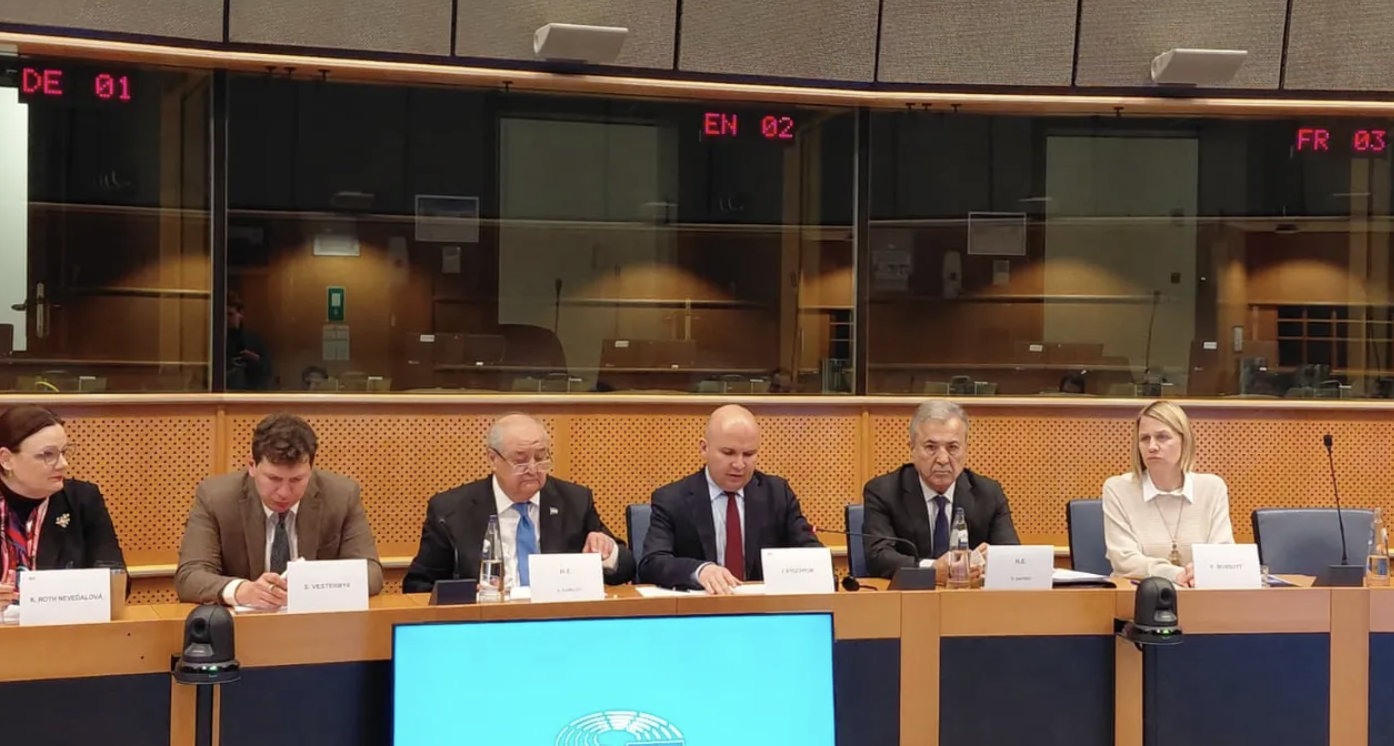
The report was first presented by ENC Managing Director, Samuel Doveri Vesterbye at a high-level event titled “Reform and Engagement: The New EU–Uzbekistan Agenda,” held on 25 February 2026 at the European Parliament in Brussels.

Hosted by MEP Ilhan Kyuchyuk, the event opened with remarks highlighting the transformative potential of the EPCA and Uzbekistan’s constructive regional role, particularly in fostering cooperation within Central Asia and maintaining engagement with Afghanistan.

The conference brought together senior EU officials, Members of the European Parliament, policy experts, and a high-level Uzbek delegation led by H.E. Sodiq Safoyev, First Deputy Chair of the Senate of Uzbekistan, and H.E. Abdulaziz Komilov, Special Representative of the President of Uzbekistan for Foreign Affairs and was moderated by ENC Academic Council Member Associate Professor Fabienne Bossuyt.

The full report is available here.

* This report was prepared with financial support from Renew Europe. Renew Europe is a centrist, pro-European political group in the European Parliament. It brings

together liberal and reform-oriented parties from across the European Union.

ENC Analysis – Helping end the war in Gaza: What does the EU get?

By Publications, Research

Helping end the war in Gaza: What does the EU get?


The European Neighbourhood Council (ENC) has released its new analysis titled “Helping End the War in Gaza: What Does the EU Get?”

The article is authored by Ebtisam Hussein, ENC Academic Council member and Associate Professor of Political Science at the University of London branch of the European Universities in Egypt.

The paper examines the European Union’s efforts to help end the war in Gaza following the Hamas attacks of October 7, 2023 and the subsequent Israeli military offensive that triggered a severe humanitarian crisis. It argues that while the EU publicly emphasizes humanitarian concerns and provides significant financial and humanitarian assistance to civilians in Gaza, its engagement is also driven by strategic interests.

The full paper is available here.

ENC Analysis – Words and Wires: Understanding Foreign Information Manipulation and Interference (FIMI) and Its Significance for the EU and Türkiye

By Publications, Research

ENC Analysis

Words and Wires: Understanding Foreign Information Manipulation and Interference (FIMI) and Why It Matters for the EU and Türkiye


The European Neighbourhood Council (ENC) has released its new analysis titled “Words and Wires: Understanding Foreign Information Manipulation and Interference (FIMI) and Its Significance for the EU and Türkiye”

The article is authored by Asuman Kubra Bas, Head of Projects and Research at ENC.

This paper examines Foreign Information Manipulation and Interference (FIMI) as a growing hybrid challenge for the European Union and its partners, including Türkiye. Drawing on the EEAS FIMI Threat Reports, open-source investigations, and new data on coordinated online behaviour, it looks at how such incidents unfold across Europe, the tactics used to carry them out, and their wider impact on both the EU and Türkiye. The paper ends with recommendations for building resilience through early coordination, behavioural monitoring, and closer cross-border cooperation within the new European Democracy Shield framework.

The full paper is available here.

ENC Analysis – Karakalpakstan: Not separatists, but separate

By Publications, Research

ENC Analysis – Karakalpakstan: Not separatists, but separate

The European Neighbourhood Council (ENC) has released its new analysis on titled”Karakalpakstan: Karakalpakstan: Not separatists, but separate

The article is authored by Bruce Pannier, a longtime journalist, ENC External Advisor, and Central Asia Fellow at the Foreign Policy Research Institute and Research Fellow at the Turan Research Center, and Fellow at the Delphi Global Research Center.

Karakalpakstan, an autonomous republic within Uzbekistan, faces profound challenges,  from the ecological collapse of the Aral Sea and severe public health impacts to political unrest and questions over cultural identity. In this ENC analysis, Bruce Pannier explores the region’s complex history, the events surrounding the July 2022 protests, ongoing development efforts, and the prospects for the Karakalpak people.

The full paper is available here.

ENC Researchers Asuman Kubra Bas, Thomas Jacobs and Samuel Doveri Vesterbye Publish New Book Chapter on Mediatized Discourses in Belgium

By Publications, Research

ENC Researchers Asuman Kubra Bas, Thomas Jacobs and Samuel Doveri Vesterbye Publish New Book Chapter on Mediatized Discourses in Belgium

ENC researchers have published a new book chapter on the representation of the EU and Europeanization in Belgian media, as part of the Mediatized EU project, funded by the EU’s Horizon 2020 programme.

The chapter appears in the newly released open access volume Mediatized Discourses on Europeanization and their Representations in European Public Spheres, published by Thomson Reuters Aranzadi. The book brings together case studies from seven countries — Belgium, Estonia, Georgia, Hungary, Ireland, Portugal, and Spain. The volume offers invaluable perspectives on the evolution of the media’s role in the process of Europeanization and how these dynamics resonate among the public, focusing on the elite–media–public triangle.

ENC’s Asuman Kubra Bas (Head of Projects & Research), Dr. Thomas Jacobs (Academic Council Member), and Samuel Doveri Vesterbye (Director) co-authored the chapter on Belgium. Their analysis reveals increasing securitization in EU-related media discourse—especially in the context of the war in Ukraine and migration—and highlights converging perspectives among elites across linguistic communities. Despite more reserved public attitudes, the chapter finds that general trust in EU institutions remains.


🔗 Read the book (Open Access): https://bit.ly/43OSiA9
🛒 Purchase print edition: https://bit.ly/4n2gsi4

We would like to sincerely acknowledge our colleagues who contributed to research, data collection, and project management throughout the four years of the Mediatized EU project, including Andreas Marazis, Dr. Tom Willaert, Maria Bevza, Katsyarina Vinnikiva, Lucia Lalikova, and many others.

Understanding and Countering Information Manipulation in Central Asia: New Research Highlights FIMI Trends in Kyrgyzstan

By Projects, Research

Understanding and Countering Information Manipulation in Central Asia: New Research Highlights FIMI Trends in Kyrgyzstan

On 21 May 2025, the European Commission’s Service for Foreign Policy Instruments, European Neighbourhood Council (ENC) and Internews Europe unveiled the preliminary findings of the pilot study “Tracking Foreign Information Manipulation and Interference (FIMI) Online: Findings from Kyrgyzstan”, funded by the European Union through the “Cultivating Audience Resilience Through Amplification of Vibrant and Authentic Narratives” (CARAVAN) project.

The study, a collaboration between the European Neighbourhood Council, Pikasa Analytics, and Internews Europe, represents a pioneering effort to analyse the evolving FIMI landscape in Kyrgyzstan through a mixed-methods approach that combines supervised Machine Learning (ML), Artificial Intelligence (AI), and qualitative verification.

Meera Selva, CEO of Internews Europe, said: “This research shows the importance of independent, cross-border and collaborative journalism that focuses on local communities. This kind of journalism delivers high-quality, trusted and relevant information that citizens need to make informed decisions about their lives and provides the best antidote to misinformation and manipulation.”

The rapid growth of digital media has opened new avenues for Foreign Information Manipulation and Interference (FIMI) to influence public opinion across the globe. Central Asia has not been immune to the global rise of information manipulation. Recent studies have documented the likely presence of FIMI across the region, often aligning with the geopolitical interests of foreign actors such as Russia and China. The scale and impact of disinformation activity have been particularly exposed during major global events, such as the COVID-19 pandemic and Russia’s full-scale invasion of Ukraine in 2022. These developments highlight the urgent need for targeted, context-specific research into how foreign information manipulation unfolds across Central Asia’s media environment.

This report presents findings from the first phase of pilot research, focused specifically on Kyrgyzstan. The findings offer a preliminary, yet detailed, portrait of Kyrgyzstan’s evolving FIMI landscape and provide insights aimed at improving methodology on FIMI and supporting policymakers, media professionals, and civil society actors working to strengthen societal resilience against foreign information manipulation and disinformation.

Beyond diagnosis, the research proposes concrete recommendations for national and international actors. These include strengthening digital literacy initiatives, supporting pluralistic and explanatory journalism, developing AI-based monitoring tools tailored to local languages, and fostering transparent media regulation that upholds freedom of expression.

Peter M. Wagner, Head of the European Commission’s Service for Foreign Policy Instruments, said: “While FIMI is a global horizontal threat, it often needs to be addressed with very targeted and context-specific responses, such as through the EU-funded CARAVAN project, which this research is part of.”

This work forms part of the broader CARAVAN initiative, funded by the European Union, and which is committed to strengthening information resilience across Central Asia.

The executive summary is available here.

ENC Analysis – Central Asia is Rising: Regional Integration, Border Resolution, and Strategic Autonomy

By Publications, Research

Central Asia is Rising: Regional Integration, Border Resolution, and Strategic Autonomy

The European Neighborhood Council (ENC) released a new analysis on “Regional Integration, Border Resolution, and Strategic Autonomy.”

The article is written by Nazerke Mukhamediya, ENC Research and Communications Assistant and Independent Researcher and Dr. Aijan Sharshenova, ENC Academic Council Member and the Executive Director at Crossroads Central Asia.

Following the Soviet Union’s collapse in 1991, Central Asia grappled with building statehood amid unresolved borders and weak infrastructure, hindering regional integration for decades. Today, however, the region shows renewed momentum for cooperation around shared goals like connectivity, water management, and global engagement. This ENC analysis examines recent milestones—including border agreements and regional forums like the C5+1—highlighting the potential for a new era of regionalism. Despite persistent challenges, the authors argue that deeper cooperation is key to Central Asia’s stability, prosperity, and growing role in the international arena.

The full analysis is available here.

ENC Analysis-France, Its Nuclear Deterrence and Europe: How to Help It Take the Leap

By Publications, Research

France, Its Nuclear Deterrence and Europe: How to Help It Take the Leap

The European Neighborhood Council (ENC) released a new analysis on “France, Its Nuclear Deterrence, and Europe: How to Help It Take the Leap.”

The article is written by ENC Academic Council Member Florian Galleri, ENC Academic Council Member and a doctor at the University of Nantes.

France has long championed a stronger European defense, yet its nuclear deterrent remains outside collective frameworks. As the EU’s only nuclear power, France faces a key challenge: balancing its strategic autonomy with the need for European security cooperation. This ENC analysis explores the tensions between France’s nuclear independence and European solidarity, the skepticism surrounding nuclear deterrence in Europe, and the potential pathways for integrating France’s nuclear capabilities into a European security framework.

The full analysis is available here.

ENC Analysis – Perceptions of Elites on the European Union and Europeanization: The Belgian Case

By Publications, Research

ENC Analysis

Perceptions of Elites on the European Union and Europeanization: The Belgian Case

The European Neighborhood Council (ENC) released its new analysis on “Perceptions of Elites on the European Union and Europeanization: The Belgian Case.”

The article is written by Asuman Kubra Bas, ENC Project Manager and Researcher and Prof. Thomas Jacobs, Professor at UCLouvain Saint-Louis Bruxelles and ENC Academic Council Member.

Belgium’s strong pro-European stance shapes its political and media debates, yet is far from being monolithic. Beyond the surface, key debates around migration, security, and economic solidarity reveal how Belgian elites interpret, negotiate, and contest European identity and values. This ENC analysis, drawing on interviews with actors from Belgium’s political and media spheres conducted MEDIATIZED EU – Mediatized Discourses on Europeanization and Their Representations in Public Perceptions Project*, demonstrates how Europe serves as a unifying yet contested idea, shaping public discourse and sparking new debates.

The full analysis is available here.

* The project was concluded in 2024 with the support from European Union’s H2020 Research and Innovation programme under grant agreement no 101004534 – Mediatized EU – H2020 – SC6 – Transformations – 2020.